Special Report from CASI Member Jim G. Munley, jr.
From - Wed Jul 19 18:42:17 2000


--part1_a0.740c2b1.26a75e54_boundary
Content-Type: text/plain; charset="US-ASCII"
Content-Transfer-Encoding: 7bit


Drought Statement
No. 10
300 PM EDT Wed., July 19, 2000

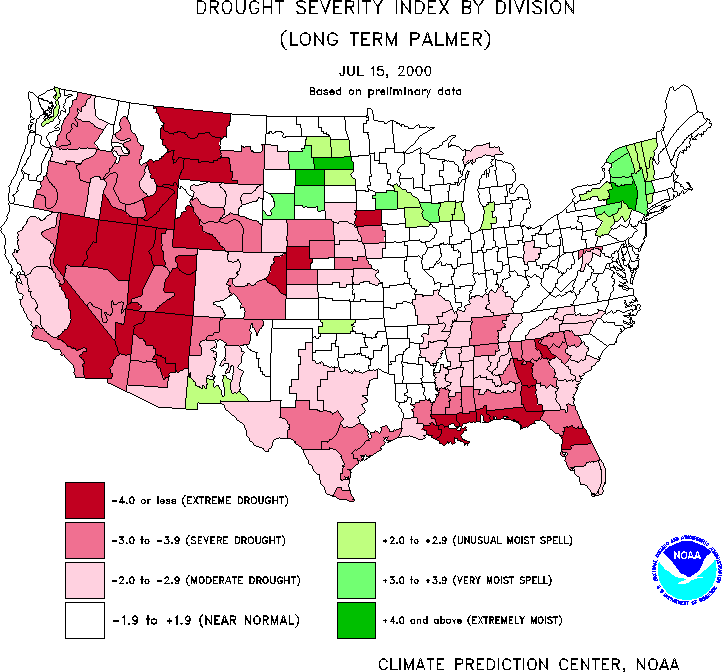
Moderate to extreme drought persists in the South. Rainfall has caused the
drought to ease in the Midwest and the central Plains.  As a result,
conditions in the Midwest improved with only pockets of moderate to severe
drought persist in areas of Ohio, Missouri, Tennessee and Kentucky.  Some
areas did not improve.
Hot and dry conditions kept extreme drought conditions across Nebraska and
expanded into Colorado and Iowa. Furthermore, many states' pastures and
rangelands were in poor or very poor condition, including Nebraska, Colorado,
and Missouri.
In the Southeast, moderate to extreme drought conditions continue to effect
many
areas. Only southern Louisiana and southern Florida reported widespread
rainfall totals approaching or exceeding an inch. This caused conditions in
southern Florida to ease, but drought conditions intensified across the rest
of the Southeast. Moderate to extreme drought conditions expanded into
Georgia and Alabama, and moderate drought conditions covered portions of the
Ohio Valley.
Farther west, hot and dry weather allowed drought conditions to increase in
coverage across central and southeastern Texas. Much of this region recorded
1 to locally 4 inches less rainfall than normal over the last 30 days.
In the West, patchy areas from the far southern Rockies and High Plains
northward through eastern Idaho and Montana received 0.2 to locally 2.00
inches
of rain, but these were generally too light and spotty to provide any
widespread, substantial relief. In fact, continued heat and dryness
caused drought conditions to expand into parts of Idaho, southwestern and
Colorado, and Utah. Moderate rains were a bit more widespread in the eastern
half of Montana and southern sections of Arizona and New Mexico.

IMPACT

In Georgia, the third straight year of extremely dry weather has threatened
endangered mollusks and aquatic life, depleted streams and reduced rivers to
record lows. Tough water-use restrictions have been imposed throughout the
state. Parts of Alabama, Florida, Nebraska, and New Mexico were declared
disaster areas due to drought, making farmers in those areas eligible for
emergency low-interest loans. Streamflow in the Southeast dropped to
precipitously low levels, and crop conditions declined markedly in many
regions. In addition, large proportions of several states' pastures were in
poor or very poor conditions, including Georgia, South Carolina, and Alabama.

OUTLOOK

In the short range, the Southeast may receive welcome rains.  The Midwest
will remain hot and dry with warm and dry conditions are expected in the
South and Southwest.  Wet conditions are expected in the Northwest.  Wet
conditions are expected in the central Plains. In the Long term, warm and dry
conditions are expected to continue in the Southeast, the central Plains and
the Southwest.  Wet conditions are expected in the Ohio Valley.

Jim Munley, jr.


Jim G. Munley, jr.,
http://www.freeyellow.com/members8/weatherman999/

--part1_a0.740c2b1.26a75e54_boundary
Content-Type: image/gif; name="palmer.gif"
Content-Transfer-Encoding: base64
Content-Disposition: inline; filename="palmer.gif"


--part1_a0.740c2b1.26a75e54_boundary--